Nisku is the working heart of Alberta’s drilling supply chain. Rental tool companies, drilling contractors and motor shops in the Nisku Industrial Park and around Leduc move bottom hole assemblies (BHAs) and downhole tools (DHT) in and out every week, and every one of those tools needs a documented inspection before it goes back down hole.
This guide explains the main inspection options (DS-1, API RP 7G-2 or your own specification) and how Buffalo Inspection Services supports Nisku-area operators from our south Edmonton facility.
What is downhole tool (DHT) inspection?
Downhole tool inspection is non-destructive testing (NDT) of the drill stem components that sit below the drill pipe: drill collars, subs, stabilizers, jars, mud motor components and other BHA parts. The goal is to find fatigue cracks, wear and damage before they cause a twist-off, a fishing job or lost rig time.
A typical BHA inspection includes:
- Cleaning: removing production oil, tar and dope so the surface can be inspected.
- Visual inspection of tool bodies and threads for washing, pitting, galling and eccentric wear.
- Magnetic particle inspection (MPI) of connections to find fatigue cracks on steel components.
- Dye (liquid) penetrant inspection to find fatigue cracks on non-magnetic components.
- Dimensional checks: measuring critical features against allowable minimums so wear can be tracked over the tool’s life.
- Ultrasonic testing to measure wall loss, or to verify and size cracks, where the program calls for it.
DS-1 inspection in Nisku
DS-1 is a drill stem inspection standard now published by Bureau Veritas (5th edition, 2020). Volumes 3 and 4 cover the inspection of used drilling equipment, including drill pipe, connections, heavy weight drill pipe (HWDP), drill collars and subs.
DS-1 is risk-based. The operator picks an inspection category that matches how demanding the well is, and the category sets which methods are applied and the acceptance criteria. Many operators and directional companies write DS-1 into their rental contracts, so a DS-1 report is often what gets a tool approved to go back out.
API inspection in Nisku (API RP 7G-2)
API RP 7G-2 is the American Petroleum Institute’s recommended practice for the inspection and classification of used drill stem elements. Some customers and equipment owners specify API rather than DS-1, especially for routine re-inspection of their own fleet.
Which should you choose? Follow your customer or operator contract first. If nothing is specified, talk to us about the well conditions and how the tool will be used, and we’ll recommend the standard and inspection level that protects you without over-inspecting.
Bottom hole assembly (BHA) inspections in Nisku
BHA components carry the highest bending loads in the drill string, and most fatigue cracks start at the connections. Regular BHA inspection between wells or at set rotating-hour intervals is the most cost-effective way to avoid failures down hole. Buffalo can set up a recurring Downhole Tool Program so your tools are inspected on a schedule and every result is recorded for trend tracking.
Why Nisku-area companies use Buffalo
- Serving Western Canada since 1979 from our head office at 3867 Roper Road in south Edmonton.
- Dedicated Downhole Tool Division with CGSB and SNT-TC-1A certified technicians in magnetic particle, penetrant and ultrasonic methods.
- Inspection to DS-1, API RP 7G-2 or your own specification.
- ISO 9001:2015 registered and CWB-certified to CSA W178.1.
- Calibrated equipment: inspection equipment goes out for calibration every six months.
- Turnaround within 24 hours for a typical BHA or tool batch.
- No-charge pickup and delivery to Nisku and Leduc yards, or on-site inspection at your yard.

Book a Nisku-area inspection
24/7 Dispatch: 780.446.8536
Office: 780.486.7344
Toll-free: 1.800.634.8588
3867 Roper Road, Edmonton, AB T6B 3S5
Frequently asked questions
Do you inspect downhole tools for companies in Nisku and Leduc?
Yes. We inspect BHAs and downhole tools for drilling contractors, rental tool companies and motor shops across the Nisku, Leduc and Edmonton area. We offer no-charge pickup and delivery to Nisku and Leduc yards, or we can inspect on site at your yard.
What is the difference between DS-1 and API inspection?
Both are recognised standards for used drill stem equipment. DS-1 uses risk-based inspection categories chosen for the well conditions; API RP 7G-2 is API’s recommended practice for inspection and classification. The tool and connection type decides which applies.
What does DHT inspection mean?
DHT stands for downhole tool. A DHT inspection is the non-destructive inspection of tools such as drill collars, subs, stabilizers and mud motor components.
How often should a BHA be inspected?
It depends on the operator’s requirements, the well conditions and rotating hours. Many programs inspect between wells; we can help you set an interval.
How do I book an inspection?
Call our 24/7 dispatch at 780.446.8536, our office at 780.486.7344, toll-free at 1.800.634.8588, or use the quote form below.
Book your downhole tool inspection
Tell us the tools, the quantity and the standard you need, and we’ll get back to you with a quote and a schedule.
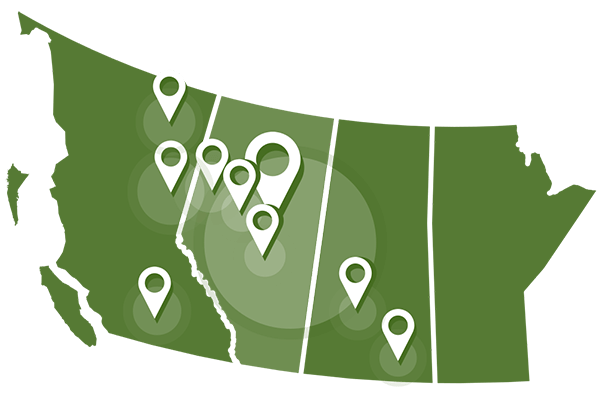
Buffalo Inspection Services Offices
Find a Buffalo Inspection crew near you.
Click to view full crew map & contact information.